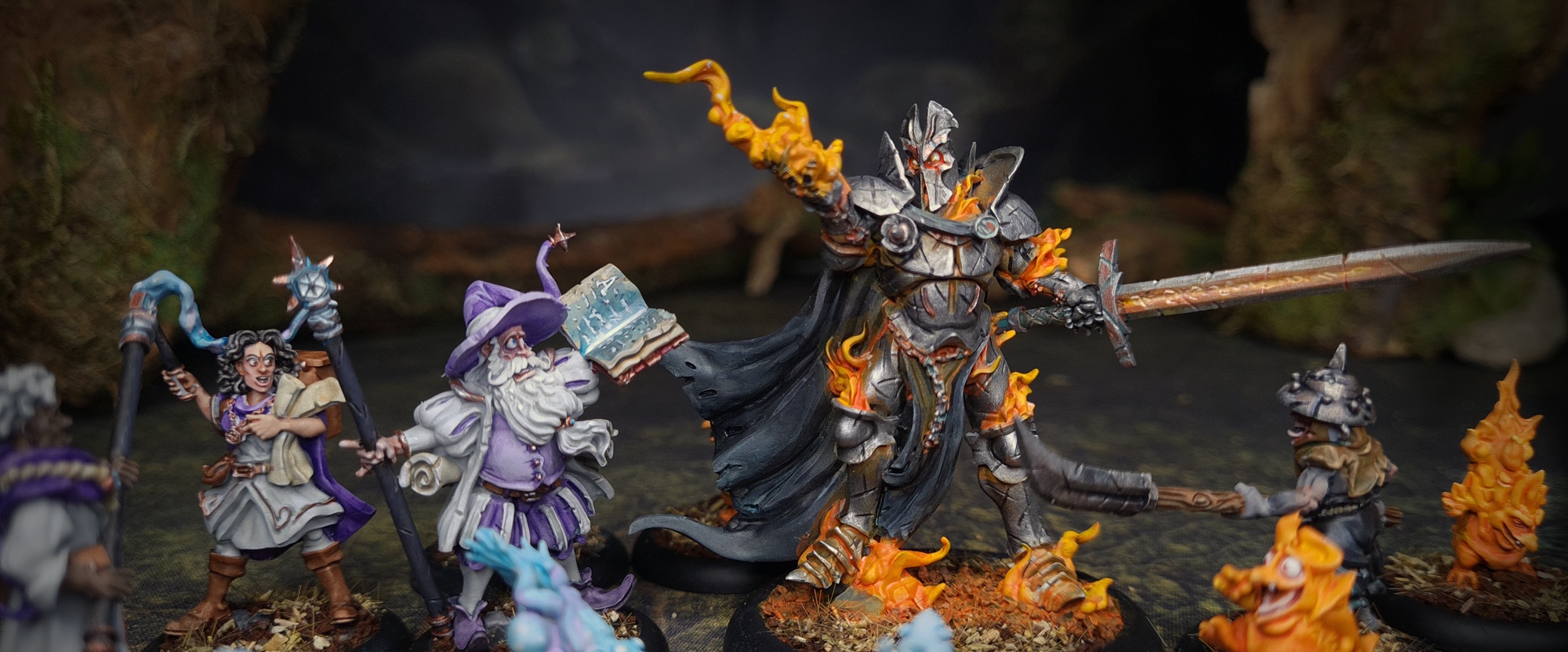
The Sfrâncioc Family Outing
-
HOUSE SFRÂNCIOC
(Sfrin-chock)Moroi Sfrâncioc has brought his family out of Vauhaemia to introduce them to the great and distinguished people of ArcWorlde. He has promised each of them a different journey, and believes that a pleasant change of scenery will bring the family closer together. Their hosts certainly remember the visit of House Sfrâncioc, although few would describe the circumstances as pleasant.
The Grand Tour
After centuries in the ancestral halls of House Sfrâncioc, Moroi decided that his family ought to get out more. They were accomplished, formidable and, in his opinion, insufficiently appreciated beyond Vauhaemia. He proposed a grand tour of the estates, courts and other distinguished households of ArcWorlde, beginning with the lands around Mildaark Forest. There would be introductions, suppers, stimulating company and, above all, time together as a family.
Moroi made the arrangements himself. To Maxim he spoke of hunting grounds beyond anything to be found at home. Carmilla heard of renowned fighters and invitations from those worth meeting. Vladislav was promised an opportunity to cultivate alliances among rulers and commanders. Alecu and his partner, Ana-Veşnica, were told of salons, collections and hosts with an interest in the arts. None of these accounts was entirely false. Moroi neglected to explain that he had invited all of them on the same expedition.
The first difficulties arose before the carriages left the castle. Vladislav wished to set the order of march. Maxim wished to travel by a different road. Carmilla wanted to know which of their prospective hosts could actually fight. Alecu suggested that they make an entrance worth remembering, and Ana-Veşnica agreed with him, though their ideas of how to accomplish it differed from Vladislav’s. Moroi listened to each objection and concluded that the family were excited.
Introductions
The Sfrânciocs are scrupulous about sending invitations and acknowledging those they receive. Moroi considers hospitality the foundation of civilised acquaintance. He takes care to address his hosts by their proper titles, brings suitable gifts, and insists that the family arrive dressed for the occasion. His manservants work hard to see that no one notices the coffins, the bats or the quantity of blood packed among their travelling necessities.
Many evenings begin well. Moroi is a learned and attentive guest. Alecu can charm a crowded room, particularly when Ana-Veşnica is there to admire his performance. Carmilla is capable of impeccable courtesy, and even Vladislav will put aside military matters long enough to discuss the quality of a host’s defences. Sooner or later, however, someone accepts a challenge they should have declined, disappears from the grounds, or reappears with an alarming devotion to one of the visitors. Invitations to return become less frequent. Moroi is pleased to hear that the family’s name is now known in places they have yet to visit.
Moroi Sfrâncioc
Patriarch of the house and a scholar of dark magic, Moroi has had many lifetimes to learn how to manage his children. He often appears weary of their disagreements, but seldom intervenes until he has decided that an intervention will matter. His affection for the family is real. So is the danger to anyone he judges to have harmed it.
Moroi has noticed that his children are most united when some unfortunate outsider gives them a common grievance. He regards this as evidence that the outing is working.
Maxim the Hunter
Maxim is happiest when he can leave the family’s carriages behind and take to the woods. Moroi’s eldest son prefers the forest to the ancestral halls and has given scarcely a thought to what it might mean to inherit them. Coarse in speech and appearance, he is easily mistaken for a creature ruled entirely by appetite. In the forest he is patient, observant and very difficult to evade. He knows which paths are used, which are watched, and when the absence of birdsong means that someone else is hunting nearby.
Maxim has little interest in his siblings’ arguments about the future of the house. Vladislav finds this both reassuring and infuriating. Maxim, for his part, cannot see why anyone would want to spend eternity settling disputes over who sits in Moroi’s chair.
Carmilla the Duellist
Second of Moroi’s children, Carmilla has earned her reputation with blade and pistol. She is courteous when issuing a challenge, exacting about its terms and seldom inclined to offer a second chance once it begins. Her ability to judge a person quickly serves her just as well away from a duel. When an evening turns dangerous, she is often the first to grasp what everyone needs to do.
Carmilla does not need to call herself her father’s heir to unsettle Vladislav. She is older, capable and quite accustomed to making decisions while he is still explaining how they ought to be made. Moroi has made no announcement about succession, and shows no sign of needing to. Vladislav therefore insists that his concerns are purely hypothetical.
Vladislav the General
Before the carriages move, Vladislav has inspected the route, arranged the household’s fighters and decided where everyone ought to ride. He has spent centuries training to lead and has dressed for the part. Few would question his courage or his skill with a blade. He wishes the same could be said of his siblings’ willingness to follow orders.
As Moroi’s second eldest son, Vladislav has long imagined that responsibility for the house might one night fall to him. Maxim appears indifferent to it; Carmilla does not. Vladislav maintains that his objections concern tradition and the orderly running of the estate. His sister has heard those objections often enough to know when he is about to make one.
Alecu the Gallant and Ana-Veşnica the Artist
Alecu, Moroi’s youngest son, has never understood why Vladislav makes command look so disagreeable. Alecu is a skilled fighter who prefers a memorable entrance, a well-chosen opponent and the pleasure of Ana-Veşnica watching him win. She, in turn, is an artist and student of dark lore whose work attracts admirers of varying degrees of willingness. Over the centuries she has painted, sculpted, played instruments, arranged flowers, practised calligraphy, studied taxidermy and redesigned entire rooms. Each pursuit holds her attention until another catches it, and each receives the full measure of her talent. Neither she nor Alecu treats the other’s interests as an eccentricity. They are each other’s most devoted audience and most dependable accomplice.
Their affection is one of the few stable things in the Sfrâncioc household. Alecu will gladly go to considerable trouble to obtain something Ana-Veşnica needs for a new work. She can find precisely the words that restore his confidence after a poor performance, though she will also tell him if his footwork was untidy. Family members seeking to turn one against the other have found the exercise unproductive.
The Household
In the villages of Vauhaemia, a place in a Vampire household is an honour that draws nearly as much suspicion as congratulations. A son taken into service means one fewer person to feed and a reliable income for those at home. He may eat better than his neighbours, sleep in a warm room and see places his family has only heard described. The work is dangerous, takes him far from home and may keep him away for most of his life. Some servants are hardly seen again while they live. Their families know enough about the lords of Vauhaemia to fear what the appointment might cost, even as they understand why someone would accept it.
Three manservants accompany the Sfrânciocs, bearing the luggage, arranging rooms, seeing to their masters’ appetites and attempting to make each visit look effortless. They are called Willikins, Wooster and Wadsworth, though by now those names belong more to the household than to the men. When one servant leaves and another takes his place, the Vampires generally address the newcomer by his predecessor’s name. The other servants have learned to give the newcomer a look which advises him to answer first and wait for an explanation. Even Moroi has forgotten who originally bore each name. The men exchange duties whenever the occasion demands. One carries refreshments on a tray, arriving at Moroi’s elbow just as the patriarch requires them.
The servants know their masters far better than their masters know them. They also know how to make a generous household work in their favour. The Sfrânciocs can recall an insult from centuries ago but seldom question the cost of supplies, the return on an investment, or the money a manservant regularly sends to his family. After many years of service, a household in Vauhaemia may owe its comfort to someone the Vampires still call by another man’s name. The manservants consider that a fair exchange for an indignity they can usually afford to overlook. Their loyalty is genuine: the work has brought them comfort, purpose and the means to care for people at home, and they take pride in doing it well. They know the risks better than anyone who watches them leave the village.
Not everyone in the household serves on those terms. Thralls attend the Vampires without question, though their obedience is nothing like the fierce, practised loyalty of the household servants. The distinction matters greatly to the Thralls, whenever they are free to remember it, and scarcely at all to most of their masters.
Ana-Veşnica is also attended by an adoring follower she calls her puppy. The Varcolac praises her work, carries what she gives him and appears harmless enough beside the rest of her admirers. Those who threaten her discover why the other servants give him room when his temper changes. Ana-Veşnica is fond of him. What he might feel without her influence is a question no one in the household has thought to ask.
Crypt Bats travel with the family and occupy whichever rafters their hosts had intended for other purposes. When the Sfrânciocs move on, the servants gather the luggage, Vladislav counts the party, and Moroi writes a gracious note thanking their hosts for an unforgettable stay. On that point, at least, host and guest are usually in agreement.