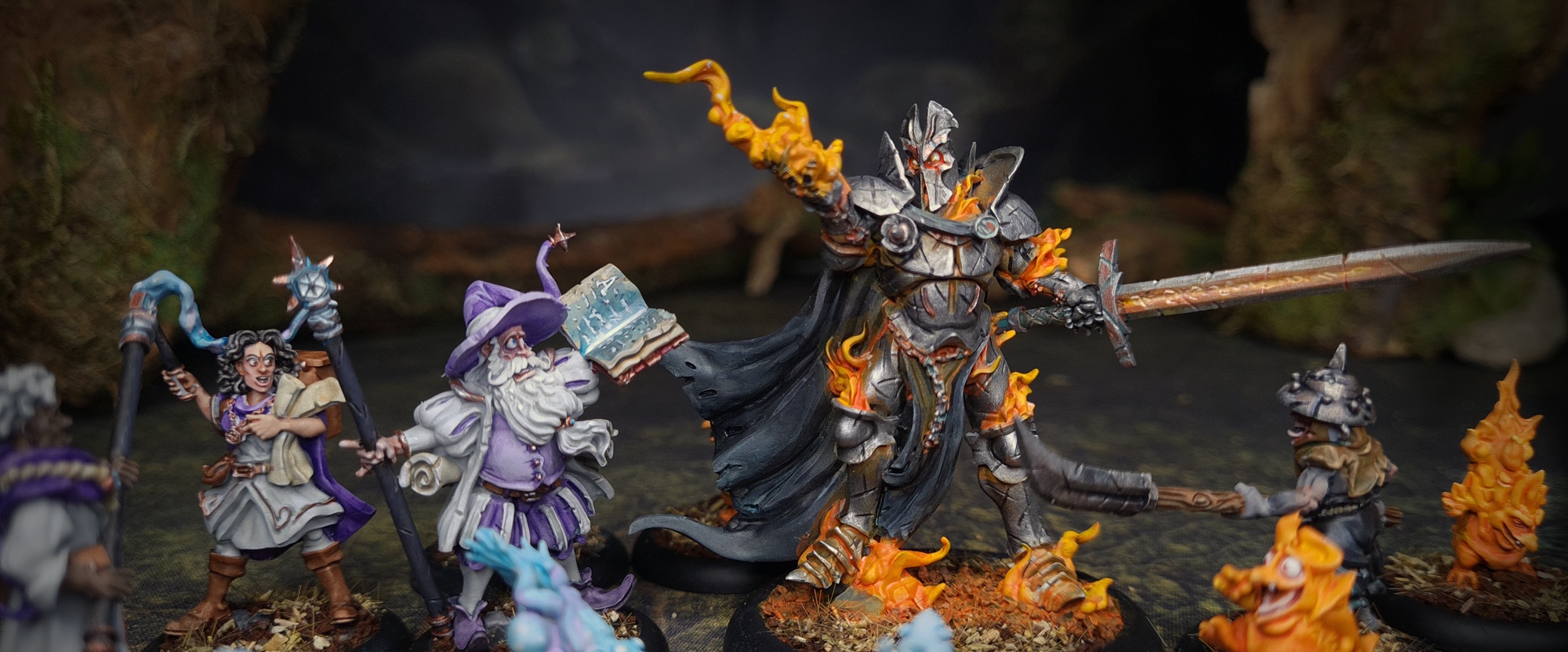
The Inevitable Dominion of Chorthor the Cruel
-
Chorthor the Cruel
Across Mildaark, scrawled notices announce that every creature, possession and patch of earth has always been the rightful property of Chorthor the Cruel. Accompanied by devoted Hobgoblins, gleeful Underlings and a bewildering host of registered beasts, this terrible Dark Lord marches to impose his will upon all ArcWorlde through fire, conquest and the meticulous correction of its administrative oversights.
The Taking of Little Ditching
The first indication that Chorthor the Cruel had laid claim to the village of Little Ditching was not the approach of an army, the burning of its fields or the appearance of a black tower upon the horizon. It was a scrawled notice in spidery handwriting, affixed to the door of every home during the night with wicked black iron nails.
The notice informed the villagers that they, their livestock, their possessions and all land extending seventeen yards beneath their feet had always been the rightful property of Chorthor the Cruel. Their continued failure to acknowledge this fact had been entered into the records as an administrative oversight, for which they were sternly reprimanded but would be graciously forgiven once the appropriate sacrifices and abasements had been made. Formal subjugation would commence on Moonsday between breakfast and noon, weather permitting.
The villagers spent the following three days preparing for massacre. When the Hobgoblins arrived, they counted the chickens, inspected the bridge and issued the miller with a citation for maintaining an unsafe ladder. They say ol’ Tommy Wilson kicked off with his pitchfork and swore he’d be buggered if he was letting any of them touch his sheep. All that was found of him afterwards was a pair of scorched boots and a few tatters of his overalls.
Little Ditching has remained under Chorthor’s rule ever since. Its people make the required obeisances, surrender the appointed portion of their harvest and are forbidden from leaving without submitting notice in triplicate. The bridge has been torn down, and in its place looms a structure of twisted, blackened metal and charred wood. The miller’s ladder has been replaced by a similarly fell and dire-looking contraption, and nobody interferes with the sheep without written permission.
The Dark Lord
Amongst the innumerable tyrants of the Dark Wastes, Chorthor the Cruel is distinguished not by the vastness of his armies, the height of his tower or the number of rivals he has cast into molten pits, although proclamations bearing his seal make impressive claims regarding all three. His particular genius lies in the administration of evil.
Chorthor does not consider himself a would-be conqueror. To conquer something would imply that it had not belonged to him already. He maintains that all ArcWorlde is his lawful and eternal dominion, its inhabitants having persisted in rebellion because earlier attempts to notify them were not properly enforced. His campaigns are therefore corrections rather than invasions. Every act of resistance is both rebellion against his authority and a personal insult.
Many tales are told of his arrival in Mildaark. Some claim that he crossed the Jernspeak Mountains at the head of a great horde, while others insist that his first party consisted of three Hobgoblins, an Underling and a cart containing several hundredweight of forms. All agree that he occupied one of the abandoned Vauhaemian watchtowers, condemned it as insufficiently ominous and immediately demanded extensive alterations. Black smoke has issued from its chimneys ever since, carrying scraps of charred parchment across the surrounding woods.
From this tower, Chorthor directs the expansion of his inevitable dominion. His decrees are delivered in a voice that shakes shutters from their hinges, his burning sword has reduced many who defied him to smoking footwear, and the flames of his displeasure are said to consume both guilty minions and the reports describing their failures. Those who laugh at his proclamations seldom laugh when he arrives to enforce them.
The Great Register
At the heart of Chorthor’s tower lies the Great Register, a collection of enormous volumes chained to black iron lecterns and guarded at all hours by Hobgoblins who cannot read them. Within these books, conquest is transformed into possession, and all the lands, creatures and treasures over which Chorthor claims dominion are recorded. Some entries describe territories already beneath his rule. Others concern kingdoms whose inhabitants have never heard his name. Several pages list places which appear not to exist at all, although Chorthor has ordered expeditions to subjugate them regardless.
Everything acquired by Chorthor’s forces must be counted, classified and entered into the Register. Treasure is weighed, livestock marked, prisoners measured and captured settlements surveyed to a depth of precisely seventeen yards. Weapons taken from the fallen are recorded before being issued to the Hobgoblin who picked them up, even when this requires the weapon to be confiscated and handed straight back.
This devotion to record-keeping has made Chorthor’s raids unusually thorough. Villages that have endured the attentions of other Dark Lords speak of burned homes, stolen food and inhabitants dragged away in chains. Those visited by Chorthor’s minions report much the same, but can usually produce an itemised receipt.
Once something has been entered into the Great Register, no other being may damage, steal or dispose of it without Chorthor’s authority. This protection extends even to his lowliest Hobgoblins, not because he feels the slightest affection for them, but because destroying another Dark Lord’s minion is warfare while destroying one of Chorthor’s minions without permission is theft.
The Administration of Evil
Chorthor’s towers seethe with a bureaucracy almost as immense as his ambition. New offices and departments spring up wherever his rule extends, each responsible for some portion of his growing dominion. Decrees pass through crooked bat-holes, messages rattle along speaking tubes and great bells summon officials who have long since forgotten which bell belongs to them.
Chained ledgers occupy entire rooms, while bundles of parchment are raised between floors in baskets pulled by Underlings. Every door bears a notice explaining who may enter, although years of smoke and amendments have rendered most of them illegible. Forms are copied in spidery hands, seals are affixed upside down and official titles grow longer whenever two Hobgoblins dispute which of them is more important. No standard has ever been introduced without creating at least three exceptions and a new office responsible for explaining them. Chorthor demands perfect order from creatures with no natural aptitude for it, yet the whole unwieldy apparatus lurches onwards.
Nevertheless, the system works with disquieting frequency. The implements of Chorthor’s rule are scrupulously counted, classified, maintained and stored for future use. Gems and precious metals are secured within his treasuries, timber is carried to his workshops and metal ores to his foundries, while Hobgoblins, slaves and other livestock are fed, housed and preserved for service in his armies. To allow any of them to fall into disrepair would be to disgrace the Dark Lord.
Honchos who squander their charges without good cause are punished for wasting their master’s property, while those who lose an entire raiding party must account for every missing minion before being issued another.
Petitions of grievance are permitted, provided they are written upon the correct parchment obtained from the appropriate official, signed by the officer against whom the grievance is being made and witnessed by a superior. Few are completed. Chorthor regards this as proof that his subjects are universally cowed, if not content.
The Minions of Chorthor
The Hobgoblins who serve Chorthor take great pride in being minions of evil. They practise cowering, sinister laughter and the brandishing of weapons in accordance with his regulations, and consider the proper completion of a cruel deed to be every bit as important as the cruelty itself. Wherever they encamp, black banners rise above palisades of charred timber, iron hooks hang from crooked posts and every available surface is improved with spikes.
Their armour is scavenged, their uniforms inconsistent and their interpretations of orders inventive. Plates overlap where they should not, helmets descend over their eyes and blades acquire additional hooks, points and serrations whenever their owners find sufficient metal. No Hobgoblin under Chorthor’s rule considers a weapon finished until it has tasted the flesh of an enemy.
Nevertheless, each knows his appointed place within Chorthor’s dominion. Even the lowliest is assigned a fell and wicked bunk, two blankets of the blackest night and a ration sufficient to preserve him for future villainy. To abandon a useful minion to hunger, exposure or an improperly documented death is considered inexcusably wasteful.
Keeping this rabble in order falls to the Honchos, large and ill-tempered Hobgoblins armed with hooked staves, cruel whips and whatever authority they can beat into those around them. They drive Chorthor’s troops forward through smoke and arrow fire, drag deserters from hiding places and settle disagreements by striking everyone involved until the truth becomes apparent. A Honcho is expected to account for every minion placed beneath his command, although battered shields, severed ears and recognisable pieces of clothing are accepted when an entire Hobgoblin cannot be produced.
Some Honchos command raiding parties, others maintain order within the towers, and a few preside over departments consisting entirely of themselves. Promotion is awarded for strength, obedience and the ability to recite Chorthor’s regulations while striking several offenders at once.
The most fervent of Chorthor’s followers are the Firestarters. To them, their master is not merely a ruler but a towering incarnation of the sacred flame. They follow his armies with blazing brands held aloft, setting fire to homes, barricades, crops and anything else which appears insufficiently devoted to Chorthor’s cause. Their eyes widen with rapture as the flames rise, and more than one has continued worshipping long after his own clothes caught fire and his flesh began to singe.
Firestarters are useful, but difficult to contain. Chorthor’s records chamber has burned three times, his western tower twice and one particularly flammable Honcho more often than anyone has troubled to count. Consequently, every Firestarter must now carry a black iron token showing which fires he has been authorised to begin. The tokens themselves are covered in spikes and sharp edges, partly for reasons of security and partly because Chorthor considered them insufficiently wicked without them.
Few Firestarters can read their authorisations, but all understand what happens when they return without having burned something.
The Underlings
Like all Dark Lords, Chorthor may divide a little of his fiery essence to create Underlings. These small creatures possess his flame, his tireless energy and his conviction that everything ought to be put in its proper place. They appear to have inherited none of his malice, although this does nothing to diminish their boundless enthusiasm for the cause of evil.
Underlings scamper through furnace mouths, tumble between the legs of marching Hobgoblins and clamber over the ironwork of Chorthor’s towers. They carry messages, weapons, seals, chains, severed heads and anything else their master places into their hands. Whether the object is a dinner order or a death warrant makes little difference to them. Both are delivered with the same delighted grin.
Witnesses to Chorthor’s attacks often speak of the Underlings with greater unease than they do his Hobgoblins. They dance among burning buildings, applaud executions and compete to see who can hammer proclamations highest upon the gates of a captured town. None appears to understand why those around them scream. They know only that they are helping, that Chorthor is pleased and that the spreading flames are extremely pretty.
During the taking of Blackbarrow, a cluster of Underlings was seen attempting to affix Chorthor’s proclamation to a gate while the defenders rained arrows upon them. Each time one was struck down, another seized the notice and continued climbing. When they finally reached the top, Chorthor detonated the entire group in a burst of fire which tore the gate from its hinges. The other Underlings cheered as the Hobgoblins poured through.
Chorthor is said to resent their cheerfulness intensely. He nevertheless relies upon them, for no Hobgoblin can match their speed, enthusiasm or ability to survive inside a burning filing chamber.
The Raiding Parties of Chorthor
Chorthor’s claims extend far beyond the reach of his marching foot soldiers. Swift bands of Hobgoblins ride forth upon Duggs, ferocious beasts descended from the wolves of Mildaark and transformed by generations of breeding in the lands around Gaulag. Little remains of the proud creatures from which they came.
Duggs are long-limbed, slavering and ill-tempered. Their jaws are heavy, their bodies gaunt and their hides bear the scars of countless fights with handlers, rivals and anything else foolish enough to stand nearby. They race across broken ground in bounding packs, howling and snapping at one another until the scent of prey gives them something else to pursue.
Their riders are little better. Draped in ragged armour and crowned with mismatched, crooked helmets, Chorthor’s raiders descend upon isolated settlements in a frenzy of blades, flame and snapping jaws. A mounted Firestarter carries Chorthor’s sacred flame ahead of them, while a Honcho drives the pack onwards with shouted threats and blows from his weapon. Those who resist are cut down. Those who flee are hunted. Those who surrender are bound, marked and carried away with everything else of value.
By the time the raiders depart, Chorthor’s sigil has been driven into doors, trees and the shields of the fallen in jagged black iron. These marks proclaim that his ownership has been restored and warn that defacing them constitutes both rebellion and theft.
The raiders return later to strip the dead and recover anything overlooked during the first attack. Weapons, armour, livestock and prisoners are carried back to Chorthor’s towers, where the spoils are counted and entered into the Great Register. Even the Duggs are recorded, branded and allotted their share of meat. A raider who returns without his Dugg faces severe punishment, while a Dugg returning without its raider is generally washed, fed and issued another.
Beasts in His Service
Above Chorthor’s marching columns circles one of the great Hellbeasts of the Dark Wastes. It roosts among the smoke-belching chimneys of his towers, filling the upper chambers with the stench of scorched meat and beating its immense wings whenever anything below becomes too quiet.
The creature is a mass of talons, leathery wings and ravenous appetite. Its great tongue hangs between crooked fangs, while its staring eyes search constantly for something small enough to seize. Chorthor has bound the beast to his immeasurable will and sends it swooping over walls and palisades to tear defenders from the battlements. Those carried into the smoke are seldom seen again, although pieces of them occasionally fall some distance away.
Hobgoblins sent to feed the Hellbeast are graciously permitted to use long iron poles and protective helmets, and are given strict instructions not to resemble food. These precautions have met with mixed success. Chorthor’s records continue to describe the creature as being in satisfactory condition.
The strangest of Chorthor’s servants is an armoured Troll taken during one of his early campaigns. Accounts disagree about whether the creature was captured, hired or simply followed the army after being fed. Whatever the truth, it now lumbers beside Chorthor’s forces clad in heavy black plates fitted with cruel points at every joint.
The Troll is driven towards gates, shield walls and fortifications which Chorthor considers unnecessarily intact. Stones and arrows strike against its armour as it smashes through timber, tears defenders from their posts and sweeps aside anything caught within reach of its enormous hammer. Between battles, it is chained within a stone enclosure beneath the tower and fed whatever the Hobgoblins are unable to identify.
The Great Register classifies the creature as a mobile siege engine. When one of Chorthor’s clerks objected that siege engines were not entitled to meals, the Troll ate him. Chorthor subsequently ruled that engines require fuel and ordered that all future feedings be recorded as maintenance.
The Forest Resists
For all Chorthor’s confidence, the Mildaark has proved a singularly uncooperative possession. Boundary posts vanish beneath twisting roots, notices are swallowed by bark and freshly surveyed paths lead somewhere different when the Hobgoblins return to measure them. Trees marked for felling stand whole the following morning, while the stumps entered into the Register are found sprouting new branches through the floors of Chorthor’s storehouses.
The Dark Lord has answered this defiance with fire and iron. Great spikes are hammered into ancient trunks, roads are gouged through root and stone, and black furnaces consume entire groves to feed the construction of his towers. Trees which conceal his proclamations are cut down as rebels. Streams which undermine his walls are choked with rubble. Wherever the forest closes around his forces, Firestarters are sent ahead to open it again.
Yet the Mildaark always returns.
Roots split the foundations of Chorthor’s towers and drag iron stakes beneath the soil. Vines crawl through arrow slits, branches twist around chimneys and pools of dark water gather in freshly dug pits. Entire patrols vanish between one boundary marker and the next. Sometimes their weapons are found hanging from the trees, each blade rusted, blunted and wrapped in flowers.
Every such insult sends Chorthor into a fury. Flames burst from the joints of his armour, Underlings scatter laughing through the tower and the surrounding forest glows red beneath the smoke. New orders are issued. Larger parties march out carrying axes, chains and armfuls of wicked black iron nails. More trees burn, more pits are dug and still more spiked towers rise above the canopy like rotten teeth.
Meanwhile, Chorthor’s servants press farther into the woods in search of Arcanite and new territories to correct. Travellers whisper that scrawled notices have begun to appear upon doors far ahead of his armies, warning that formal subjugation is imminent and resistance must be registered in advance. Most laugh when they read them.
Those who have seen what remained of ol’ Tommy Wilson seldom join in.