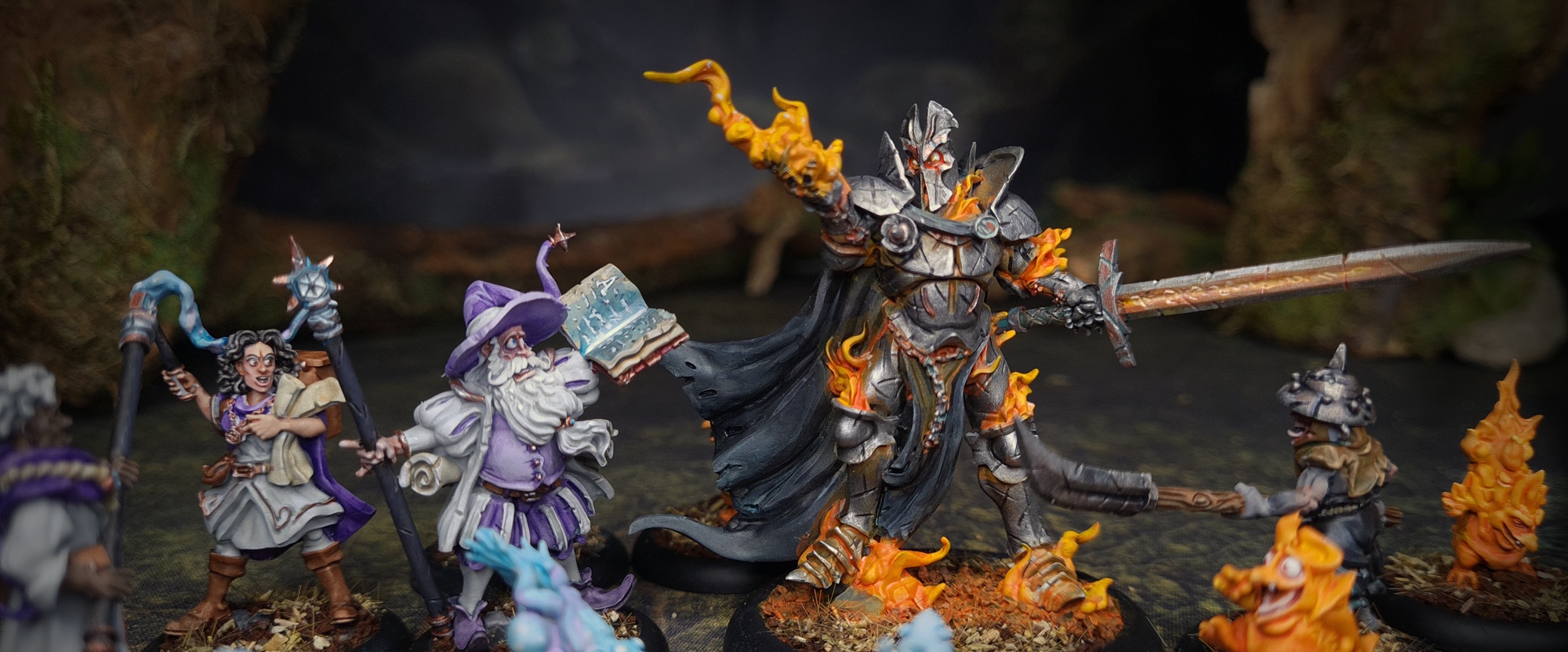
The Oathbound: The Honour Guard of Ælfric the Just
-
THE OATHBOUND
Ælfric the Just, last king of ancient Ælbion, and his twelve Oathbound companions have risen once more. Still sworn to protect the people and uphold justice, these legendary Dead fight beside honourable souls of every nation and kind. Why they have returned is unknown, but it seems that there is still work to be done.
ÆLFRIC THE JUST
Long before the rise of the Albionnican Empire, before the Alabaster Council and the centuries of warfare from which it was born, the island was said to have been a single kingdom named Ælbion.
How much of what is remembered about that kingdom is history and how much is legend is now impossible to say. Its halls have fallen, its boundaries have been forgotten and even its name survives only in the grander title of the nation that followed it. Nevertheless, stories of its last king are still told throughout Albionnica.
Ælfric the Just is remembered as the greatest and last of the kings of Ælbion. In some tales he united the island through conquest, in others through wisdom, while a few insist that the crown was placed upon his head by a mysterious figure who walked out of a sacred bog. All agree that Ælfric believed a ruler held power only so long as it was used for the good of the people. He was said to hear the poorest petitioner as readily as the greatest lord, and to judge each by the same law.
Whether the living Ælfric ever truly matched the king of legend hardly matters now. For nearly two thousand years his name has represented the promise that authority is a duty rather than a reward, and that no title can make injustice lawful.
Ælfric was accompanied by twelve great companions, collectively remembered as the Oathbound. Some stories make them the rulers of Ælbion’s twelve ancient realms, while others describe them as warriors drawn from every part of the kingdom and every station within it. Each has accumulated their own cycle of adventures, many of which contradict the others, but all are said to have sworn the same oath as their king: to preserve the peace of Ælbion, protect its people and uphold justice without fear or favour.
The oath did not bind them to obey Ælfric blindly. It bound king and companions alike to the same duty.
Old songs describe the Twelve seated with Ælfric around a great circular Oathstone, with no companion raised above another. Much later, when the warring lords of Albionnica finally agreed to peace, the twelve equal seats of the Alabaster Council were supposedly modelled upon this legendary court. Several of the Council’s great families still claim descent from one or another of the Oathbound, although their genealogies seldom agree and become particularly imaginative wherever inheritance or property is involved.
Whatever truth lies behind those claims, the comparison is not always flattering. The Twelve were remembered as equals because each had sworn to serve. The lords of the Alabaster Council have increasingly come to regard themselves as equals because each believes they possess an equal entitlement to rule.
Many figures pass in and out of the legends surrounding Ælfric’s court. Foremost among them is a Bog Magus whose name, nature and loyalties change with every telling. They appear by turns as Ælfric’s teacher, counsellor, adversary and the architect of the trials that made him worthy to rule. They are credited with placing the crown upon his head, warning that no child of his blood would inherit it, bringing him to his final resting place and ensuring that he would one day rise from it. The Magus has never been known to settle the matter.
Another famous tale concerns one of the Twelve and a great giant from the wild places of ancient Ælbion. The details vary wildly, but the knight is always tested as much by a promise as by strength of arms. By keeping their word when doing so appears certain to cost them their life, the knight wins the giant’s respect and, eventually, its friendship. Later stories place the giant beside Ælfric in his final battles. Whether the enormous skeletal warrior now seen among the Oathbound is truly that ancient giant, or merely something assembled in its image by the returning dead, is a favourite subject of argument among antiquarians who have never encountered it themselves.
Ælfric died without an heir. Some legends say that no child of his survived infancy; others insist that he refused to name an unworthy successor. Stranger tales maintain that his heir still lives somewhere beyond the known lands of ArcWorlde and will return at the appointed hour. Whatever the truth, no claimant after Ælfric’s death commanded the loyalty he had inspired.
The great lords fought over the empty throne and Ælbion fractured. The feuding realms that followed warred for centuries before their exhausted descendants formed the Alabaster Council. Ælfric, his companions and the other heroes of his court passed into folklore. It was said that the last king had not truly died, but merely slept beneath the earth with the Oathbound gathered around him. When Ælbion faced its greatest need, the Once and Future King would rise and walk the land again.
As is often the way with ancient promises, people apparently failed to consider precisely what two thousand years beneath the earth might do to him.
Nobody knows why the Oathbound have awakened now. Priests and patriots blame the corruption of the Alabaster Council and the breaking of the ancient compact between ruler and people. Treasure hunters speak of a relic stolen from Ælfric’s barrow, or of some treasure lost during the fall of Ælbion which the dead king has returned to recover. Others tell of an innocent subject calling upon the Just King when no living authority would hear them. Darker prophecies treat his return as a warning of some catastrophe yet to come. Imperial scholars prefer explanations involving disturbed burial chambers, unstable Arcanite and regrettably unsupervised excavation.
Nothing in the surviving accounts suggests that Ælfric has offered an explanation. The dead king and his followers appear to act as though their duty never ended. Perhaps, to them, it did not.
One of the earliest modern stories concerning the Oathbound comes from a remote Imperial garrison in the Mildaark Rimlands. The soldiers stationed there had been left without reinforcements and were preparing to be overwhelmed when unfamiliar warriors appeared among the defenders shortly before midnight. In the darkness, they were assumed to be Mildaark Irregulars or some other friendly force. Their armour and weapons appeared strangely old-fashioned, but the exhausted soldiers had little opportunity to question welcome assistance.
Only when the clouds parted did the moonlight reveal bronze-clad skeletons standing in the line beside them. Arrows passed between their ribs, shattered warriors pulled themselves back together and a great shape of mismatched bone drove into the attackers. Witnesses also described a pale figure surrounded by the vapours of a stagnant mire, although the official report dismisses this as smoke, fog or fatigue.
The garrison held.
At the battle’s end, the surviving Imperial sergeant reportedly found the dead king watching him across the ruined palisade. The ancient warrior placed a hand against his breast and raised his sword in a gesture the sergeant recognised as an archaic predecessor of the Imperial salute. He returned it. Clouds passed across the moon and, when the light returned, the Oathbound were gone.
The Imperial authorities attributed the story to exhaustion and exposure. This might have been more convincing had every surviving soldier not given substantially the same account.
Another frequently repeated story concerns an Imperial detachment that took control of a bridge along an important road through the Rimlands. Its captain claimed to be collecting taxes on behalf of the Alabaster Council, although no two travellers were charged the same amount and anything desirable was liable to be confiscated as payment in kind. Those unable or unwilling to pay were beaten, imprisoned or simply driven into the forest.
One evening, as mist gathered upon the river, armed figures approached along the road. The sentries took them for another Imperial patrol until the figures reached the bridge.
According to the soldiers who survived, their leader demanded that the captain present the authority by which he obstructed the King’s road and took goods from the people. The captain invoked the Alabaster Council and ordered the strangers to leave. Accounts disagree about the answer. Some say the ancient king declared that the Council’s authority endured only while it was exercised for the good of the people. Others remember nothing more than the words, “Then let the Council answer for you.”
The captain ordered his troops to fire.
At that moment the moon emerged from behind the clouds. Its light passed through empty ribcages and gleamed upon weapons green with age. Something enormous moved in the mist behind them, and a lone figure wreathed in marsh vapours watched from the riverbank.
The Imperial detachment broke and fled.
Those who returned the following morning found the bridge deserted. Confiscated goods had been laid beside the road, while the contents of the toll chest had been separated into neat piles. The captain was discovered alive, bound to the tollpost with his fraudulent proclamations pinned to his uniform. No footprints led away from the bridge.
Officially, the crossing had suffered an attack by a hostile skeletal warband. Those living nearby still call the incident the Judgement at the Bridge.
The Beastfolk carry another account in song. Their Warbards tell of a Roamer clan overtaken in the marshes by Hobgoblin slavers seeking captives among the plunder. The strongest members of the clan might have escaped, but their elders, their injured and their young could not have kept ahead of the pursuit. The Roamers therefore stopped.
The Clanbeasts formed a ring around those who could not fight, while the Vermen filled the spaces between them with spears, shields and whatever weapons remained. Their Warbard played as they made their stand, carrying the name of the clan above the shouting of the Hobgoblins. They fought fiercely, but there were too few of them. The ring bent beneath attacks from every side, and the defenders could no longer close every opening without creating another.
Then mist began to rise from the marsh.
Ancient warriors emerged through it, bronze weapons green with age and rotted cloth hanging from their spears. They took their places in the failing ring without command or introduction. Battered bronze shields closed the gaps between the living, and a warhorn answered the skirl of the Warbard’s pipes.
The ring held.
The Hobgoblins fled or fell, leaving their intended captives untouched within the circle. When the fighting was done, the dead king saluted the Roamers. The Warbard answered with a final call upon the pipes. Then the mist closed around the Oathbound, and they were gone before the Warbard had found an ending for the song.
The song has travelled far beyond the clan whose name it first carried. Its verses change between tellings, as Beastfolk songs are inclined to do, but every version agrees upon one thing: the dead did not come because the Roamers were blameless. They came because the Roamers would not abandon their own.
Similar stories now follow the Oathbound throughout Mildaark. Allegiance, ancestry and form of life appear to matter less to them than whether someone protects others, keeps faith and places duty above their own safety.
On rare occasions, Ælfric or one of the Twelve offers a formal salute to someone among the living. An Albionnican soldier may recognise the ancient gesture and return it, while those from other lands answer according to their own customs. The Oathbound appear to regard either response as sufficient. It is the closest they have come to acknowledging those they help. Neither the salute nor the words attributed to Ælfric at the bridge explain why they returned.
This has proven deeply inconvenient for the Alabaster Council. Ælfric the Just is a beloved symbol of Albionnica’s ancient greatness, but the returned king has shown no particular respect for modern uniforms, titles or territorial ambitions. He may rescue Imperial soldiers abandoned to die one night and drive other Imperial troops from a stolen bridge the next. Those who hoped to claim his legend as proof of their own authority have instead found themselves measured against it.
Ælfric has made no recorded claim upon the throne of Albionnica, nor issued any challenge to the Alabaster Council. The Oathbound do not march beneath proclamations, recruit followers or remain to receive gratitude. They arrive without warning, act without explanation and disappear again into darkness and mist.
Among the ordinary people of the Empire, an old saying has begun to circulate whenever another story of the dead king is told:
They do not ask beneath whose banner you stand, but what you stood for beneath it.